18. Advantages of an Operating System
An operating system provides several advantages:
1. Ease of use: It makes computer operations easier through an interface.
2. Efficient resource management: It coordinates processor time, memory, storage, and other resources.
3. Application support: It provides the environment required for applications to run.
4. File organization: It makes it easier to create, organize, locate, and manage files and folders.
5. Hardware coordination: It helps the computer communicate with supported devices.
6. Multitasking: It allows users to work with multiple applications, subject to available resources.
7. Security features: It can provide user accounts, access permissions, and other protective features.
8. System configuration: It offers tools for changing settings and managing certain system components.
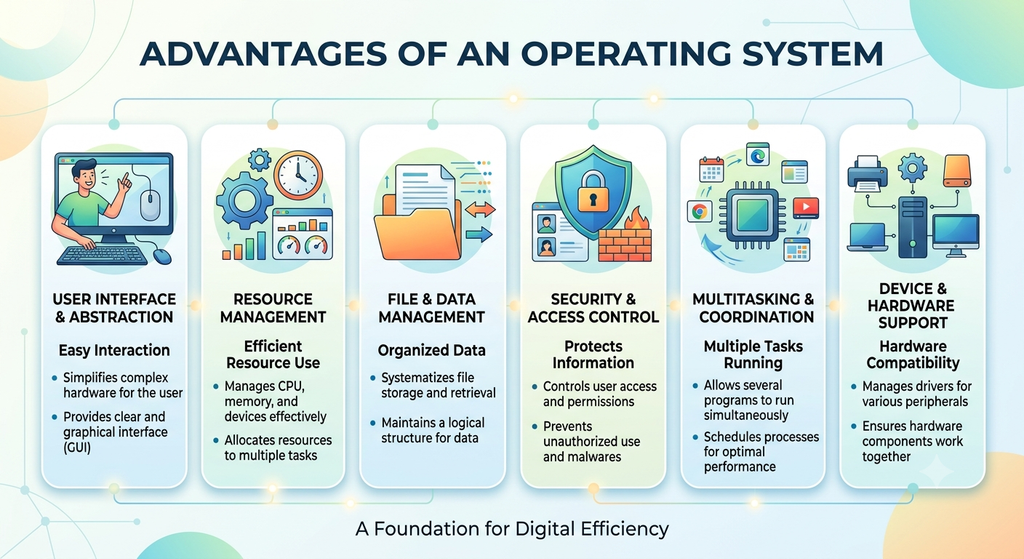
These advantages make an operating system essential for ordinary computer use.
19. Difference Between an Operating System and an Application
An operating system and an application program are both types of software, but they serve different purposes.
| Operating System | Application Software |
|---|---|
| Manages hardware and system resources. | Performs particular tasks for users. |
| Provides the environment in which applications run. | Uses the operating system’s services to perform its work. |
| Helps manage files, memory, processes, and devices. | Helps users create documents, calculate values, draw pictures, and perform other tasks. |
| Examples include Windows, Linux, and macOS. | Examples include word processors, spreadsheet programs, Paint, and web browsers. |
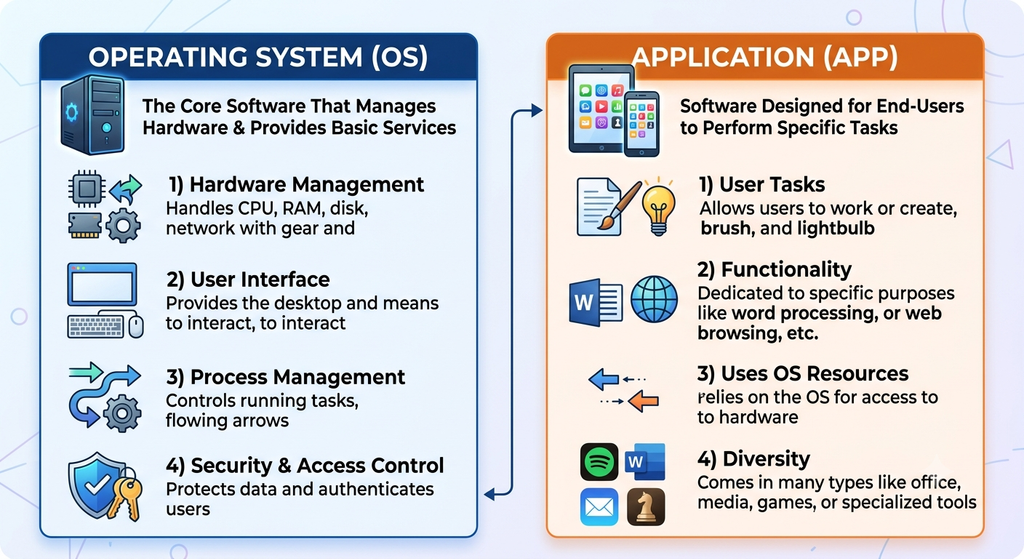
For example, Windows is an operating system, while a word processor is an application used to create and edit documents.